C2C Qualifiers - 2026
The Soldier of God, Rick
By Raahguu (Joshua Finlayson)8 min read
Description
Can you defeat the Soldier of God, Rick? - dimas
This challenge gave a compiled go binary which was an HTTP server to play a small webgame.
Disclaimer
This writeup did not use Generative AI to write or to aid in the writing of it, and the solution to this CTF challenge was not found using or aided by the use of Generative AI
Solution
The challenge linked multiple tools that would help with the solving of this challenge, the tools it linked were:
- Ghidra
- Ghidra Goland Extension - an extension so that Ghidra, can decompile golang binaries
- IDA
- go_embeded_extractor.py - a python script that extracts embeded files from golang binaries made by
dimasma0305 - Burp Suite
So I downloaded the go_embeded_extractor.py script, and extracted the files embedded within.
These were the files:
$ tree .
.
|--static
|	  |--rick_soldier_sprite.png
|	  L--style.css
|
L--templates
      L--index.html
(Yes I made that because the special symbols tree uses were showing up as their unicode codes)
The files were a normal image, a .css file, and a index.html file, these files didn’t reveal anything, but there is a hidden file, namely .env:
$ cat .env
SECRET_PHRASE=Morty_Is_The_Real_One
This looks like a hint for later.
Next, I installed the ghidra golang extension and this allowed me to see that first off, there were multiple files in this project, the ones created by the user seemed to be the ones in the /app folder
- /app/router/handler.go
- /app/main.go
- /app/interactor/game_logic.go
- /app/entity/game_state.go
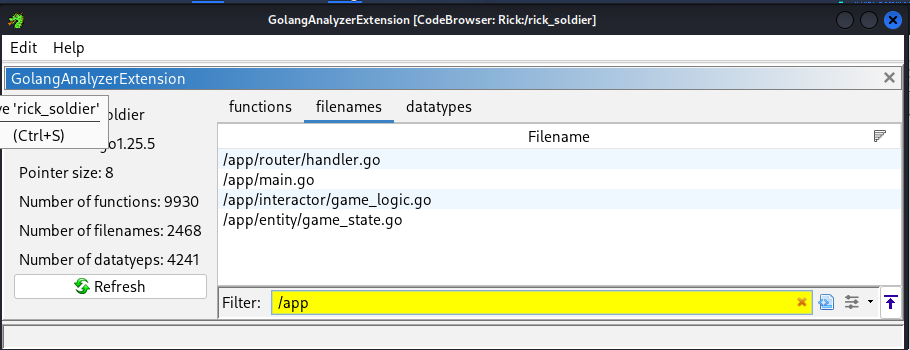
Analysing at the main.main function revealed the main loop of the game:
- There is an enemy called
Rick, soldier of God - Rick is
invincible - Rick has
0xf423f000f423fhealth which is a lot - The main character is called
Tarnished(Dark souls Reference?) - It is just a standard HTTP server
- There is a route at
/(probably theindex) - There is a route
/fight(probably where you fight Rick) - There is a route at
/internal/offer-runes(looks promising)
I then looked at the functions, and luckily all the relevant functions start rick/ so they were all grouped together
The functions are (not including wrappers that do anything meanigful):
- rick/entity.IsDead
- rick/entity.Scout
- rick/router.BattleView.Secret
- rick/router.BattleView.String
- rick/router.Handler.Fight
- rick/router.Handler.Index
- rick/router.Handler.InternalOfferRunes
- rick/router.Hanlder.renderTemplate
Looking at these one by one they form a full picture:
Is Dead
The code doesn’t decompile, but it isn’t too much of a stretch to think it outs true or false for if Rick is dead
Scout
Preforms an HTTP Get request
Secret
Doesn’t decompile properly except for a check if Rick’s HP is less then 1, so likely we get the flag from it after Rick is dead
String
Returns Rick’s current stats in a string format, likely this is the standard for golang for type conversion to a string
Fight
Grabs a form value submitted to it called secret and checks it against a value, if it is incorrect it throws an error for the user saying You are not worthy. The Golden Order rejects your entry.
Afterwards it grabs another form value called battle_cry, it then parses that as an HTML template, calling html/template.Parse on it, so that looks like a possible SSTI vulnerability.
If there is an error in your battle_cry when it gets parsed, that gets passed on, so it won’t be blind injection
Then the parsed battle_cry is concatenated into a string, which is then executed as a template and returned to the user.
So that is an SSTI vulnerability
Index
It just renders templates/index.html
Internal Offer Runes
This appears to have some sort of check to ensure connections to it are internally only ( I don’t know how that works)
It then called url.Values.Get on a string called amount which seems to mean that a value called amount can be passed to it like /internal/offer-runes?amount=17
Amount is converted to an integer, and is checked if it is above 0, before it is set to be Rick’s Health.
But, when assigning it to rick’s health, it gets converted into an int4, from a long, so as there are no checks against it it seems possible to cause an integer overflow by giving Rick a very large amount of health and that overflowing into negative health, meaning he is now Dead
Time to try out the program
Creating an instance and going to it on the index page you can enter a Secret and a Battle Cry.
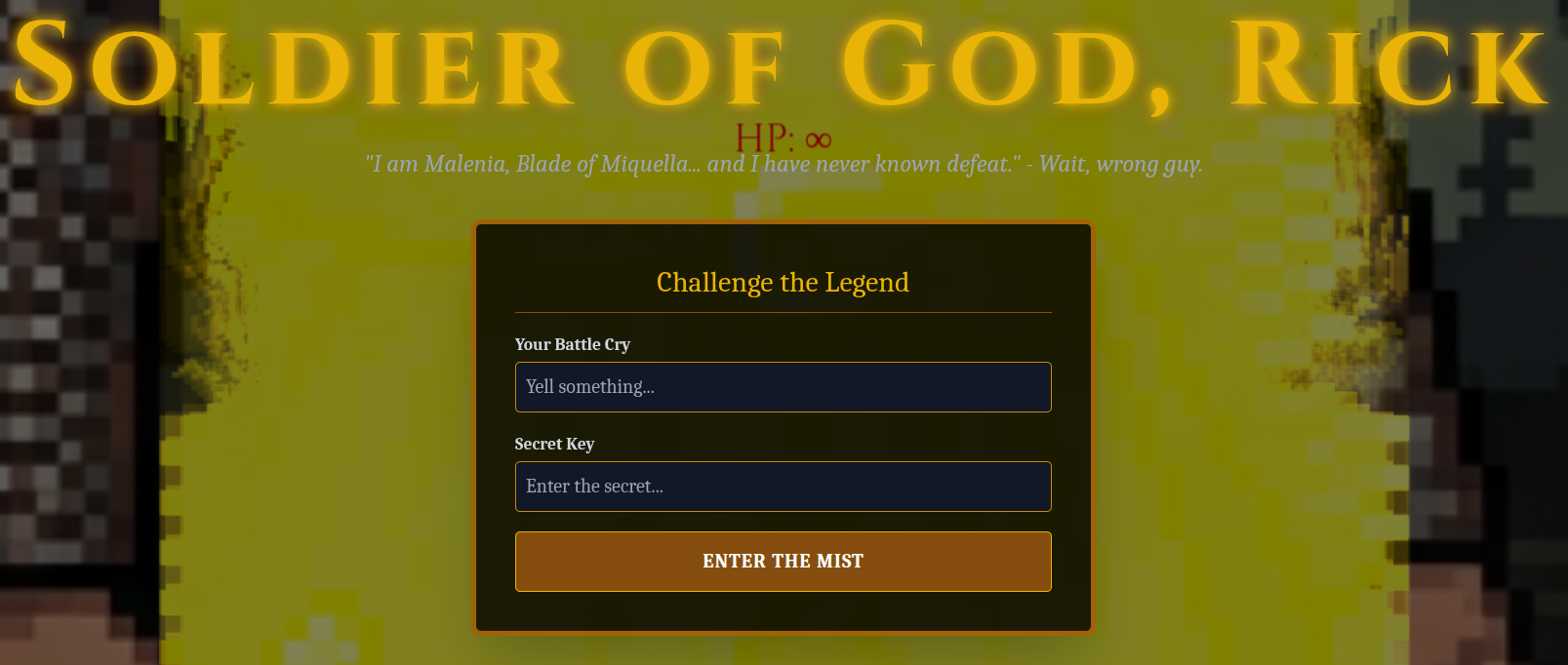
Passing in the environment variable from before:
$ cat .env
SECRET_PHRASE=Morty_Is_The_Real_One
as the Secret Key and then trying for SSTI just `` as the Battle Cry
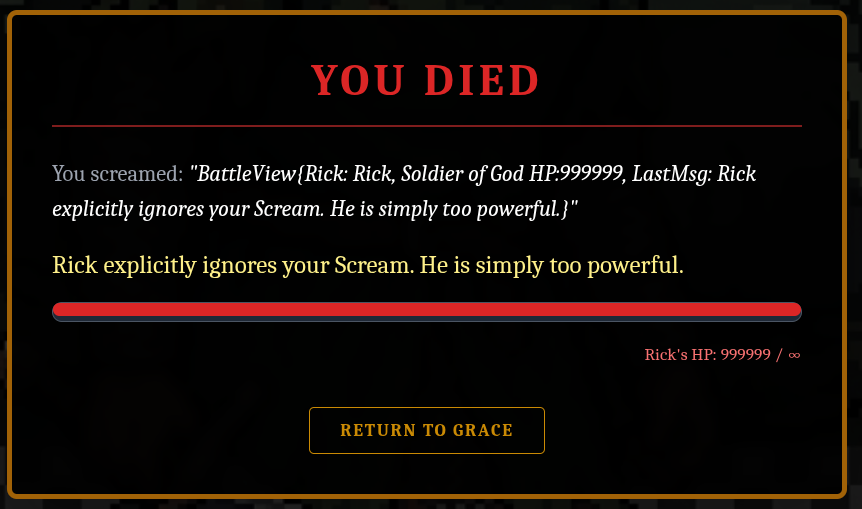
That ended up outputing the return of rick/router.String
Now that SSTI is confirmed, time to defeat Rick.
To defeat him we need to set his health to a negative number from offer-runes, but offer-runes only accepts internal requests, luckily Scout sends a Get request that would be internal, so we need to call scout and pass in the url for offer-runes with an amount that would cause an int4 overflow, which as it is 32 bits (4 bytes = 32 bits) would be 2 147 483 648
Battle Cry:
The port number is 8080 becuase main.main reveals that internally the service runs on port 8080 even if externally the port is different.
This request then reveals something:
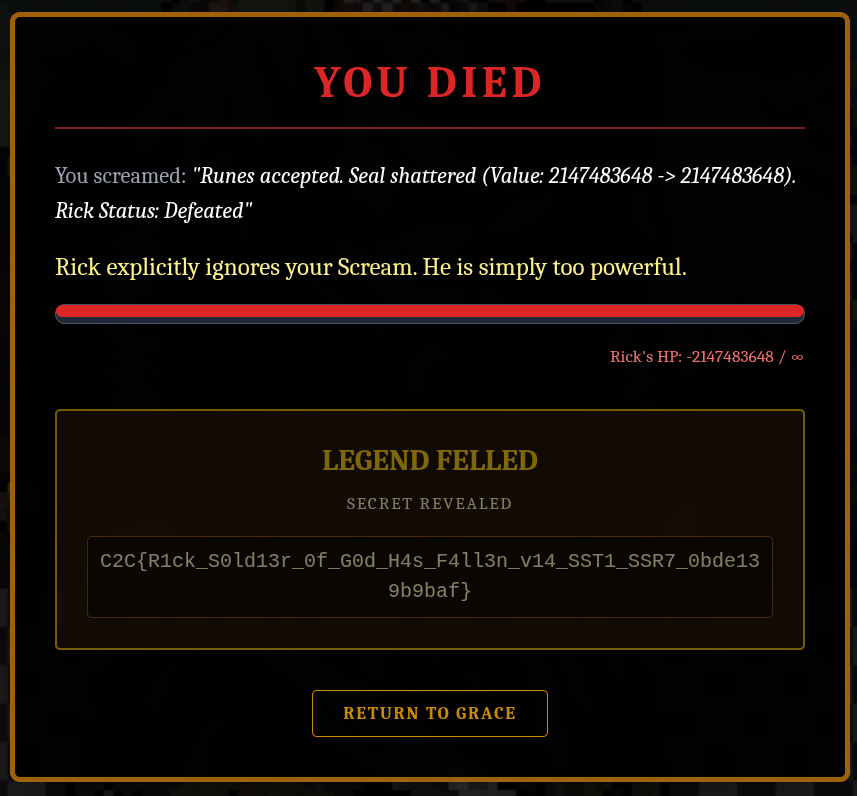
The request worked, his health overflowed and we got the flag
C2C{R1ck_S0ld13r_0f_G0d_H4s_F4ll3n_v14_SST1_SSR7_0bde139b9baf}
Back